IMPLEMENTATION OF MEANINGFUL PARTICIPATION IN THE FORMULATION OF REGULATIONS CONCERNING THE DANANTARA INVESTMENT MANAGEMENT AGENCY
DOI:
https://doi.org/10.55292/xfvxsb52Keywords:
Meaningful Participation, Danantara, Participatory Procedures, Regulatory FormulationAbstract
Danantara, as Indonesia’s leading investment management agency, is expected to play a considerable role in Indonesia’s economic development, particularly in driving the operational and investment management of national state-owned enterprises. Due to its importance, Danantara’s regulatory formulation requires public participation to achieve efficacy in Danantara’s working system. This paper aims to investigate the institutionalized participatory procedures and mechanisms that can facilitate meaningful participation, which can then be applied to assess the presence of meaningful involvement in the enactment of Danantara’s regulation. Using a normative approach, this paper concludes that Indonesian laws and precedents have focused more on procedural issues, which are not supported by the broadening of methods and mechanisms for public consultation and the dissemination of information. Consequently, public participation is arduous to achieve, including in the establishment of Danantara’s Regulation.
Downloads
Published
Issue
Section
License
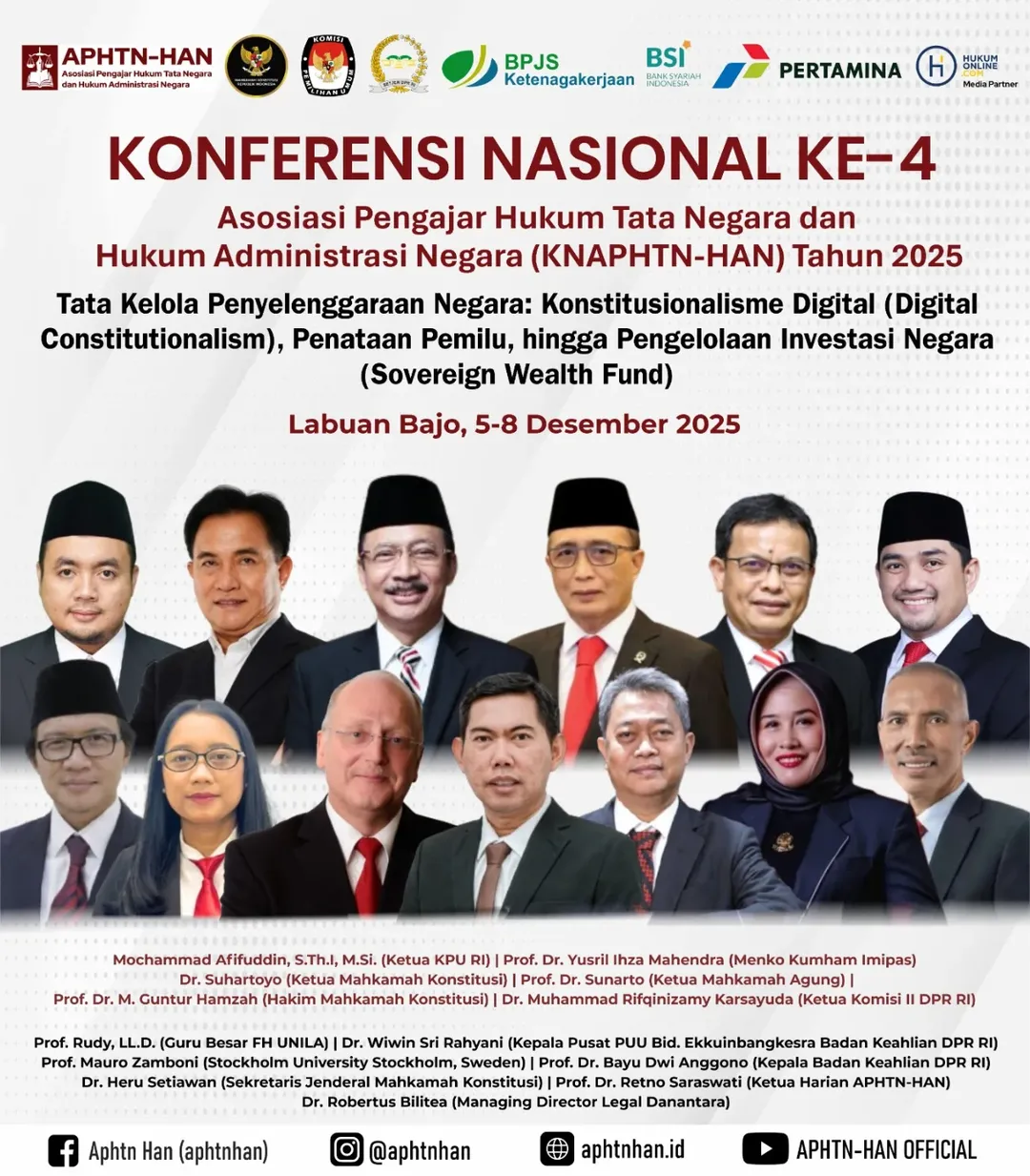
Copyright (c) 2025 Konferensi Nasional Asosiasi Pengajar Hukum Tata Negara dan Hukum Administrasi Negara

This work is licensed under a Creative Commons Attribution-NonCommercial-ShareAlike 4.0 International License.
All articles published in Proceeding APHTNHAN are licensed under the Creative Commons Attribution-NonCommercial-ShareAlike 4.0 International License (CC BY-NC-SA 4.0).
This license allows others to:
-
Share. copy and redistribute the material in any medium or format
-
Adapt. remix, transform, and build upon the material
Under the following terms:
-
Attribution. You must give appropriate credit, provide a link to the license, and indicate if changes were made.
-
NonCommercial. You may not use the material for commercial purposes.
-
ShareAlike. If you remix, transform, or build upon the material, you must distribute your contributions under the same license as the original.
More details about this license are available at: https://creativecommons.org/licenses/by-nc-sa/4.0/
Authors retain the copyright of their work and grant Proceeding APHTNHAN the right of first publication with the work simultaneously licensed under the CC BY-NC-SA 4.0 license.






 © 2025 Proceeding APHTN-HAN