INDIGENOUS PEOPLE’ PARTICIPATIONS IN THE LAW-MAKING PROCESS: A COMPARATIVE STUDY OF INDONESIA AND CONSULTA PREVIA LENS IN BOLIVIA
DOI:
https://doi.org/10.55292/sywnt657Keywords:
Consulta Previa, Meaningful Participation, Indigenous Peoples, Legislative ProcessAbstract
Indonesia constitutionally defines itself as a rechtsstaat grounded in democracy and popular sovereignty, where every law must reflect the will and welfare of the people. The Constitutional Court affirms that legislation-making must guarantee public participation as a manifestation of democratic legitimacy. However, the involvement of indigenous peoples in Indonesia’s legislative process remains weak, limited to symbolic participation without meaningful influence on policy outcomes. This study aims to compare Indonesia’s mechanism for indigenous participation in law-making with Bolivia’s consulta previa system, which institutionalizes the Free, Prior and Informed Consent (FPIC) principle as a constitutional right. Employing a normative juridical method and comparative legal analysis, this research examines constitutional provisions, statutory frameworks, and international norms, including the UN Declaration on the Rights of Indigenous Peoples (UNDRIP) and ILO Convention No. 169. The findings reveal that while Indonesia has acknowledged indigenous rights through Article 18B (2) of the 1945 Constitution and sectoral regulations such as the Forestry Law, the absence of a specific legal mechanism for consultation leads to repeated conflicts, especially concerning land and resource governance. In contrast, Bolivia’s consulta previa establishes a binding consultation process that empowers indigenous communities to influence decisions affecting their territories. This research method is a normative legal study with concludes that adopting a contextualized version of consulta previa in Indonesia could enhance substantive democracy, ensure equitable development, and prevent state-driven marginalization of indigenous communities within legislative and policy frameworks.
Downloads
Published
Issue
Section
License
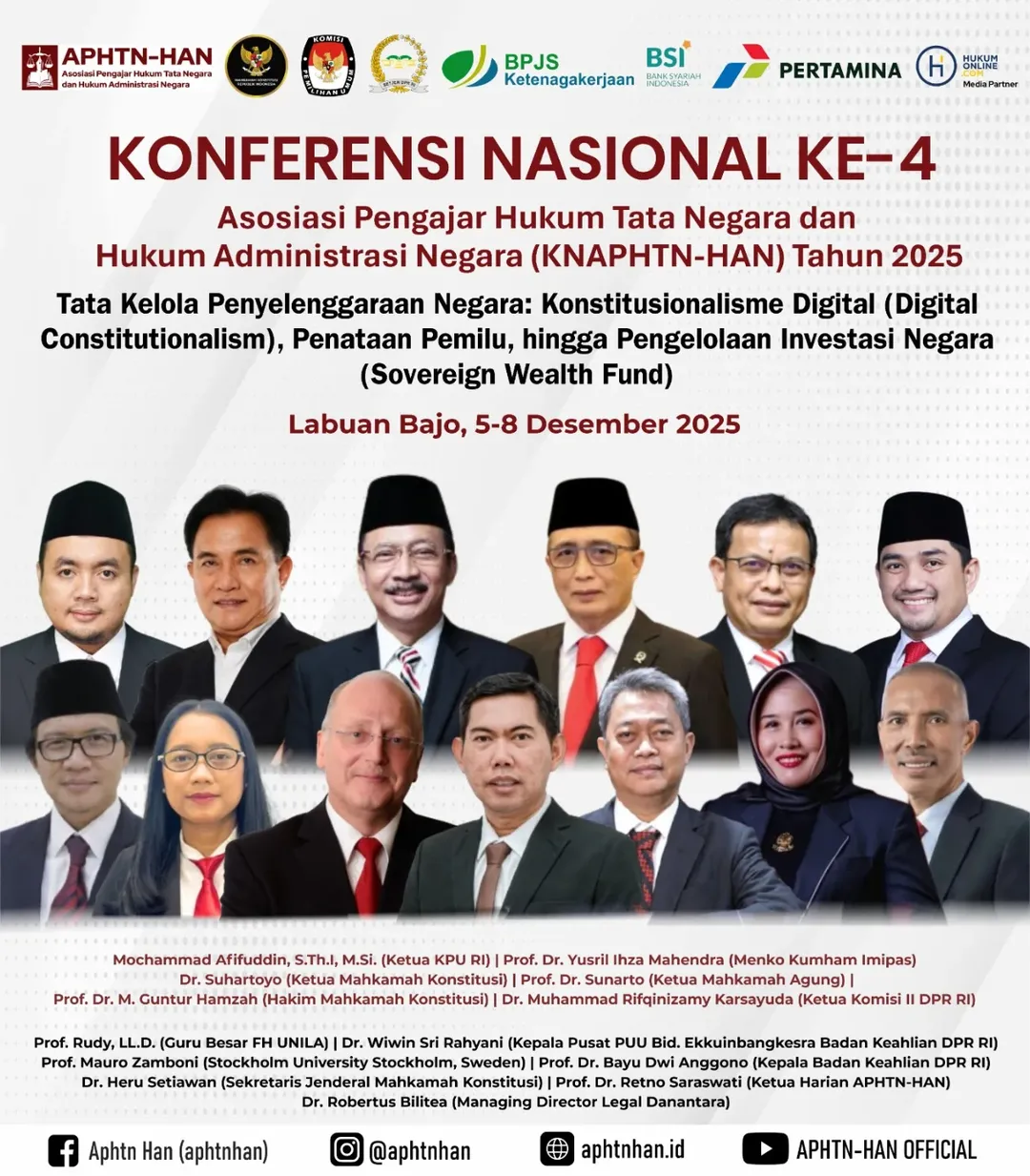
Copyright (c) 2025 Konferensi Nasional Asosiasi Pengajar Hukum Tata Negara dan Hukum Administrasi Negara

This work is licensed under a Creative Commons Attribution-NonCommercial-ShareAlike 4.0 International License.
All articles published in Proceeding APHTNHAN are licensed under the Creative Commons Attribution-NonCommercial-ShareAlike 4.0 International License (CC BY-NC-SA 4.0).
This license allows others to:
-
Share. copy and redistribute the material in any medium or format
-
Adapt. remix, transform, and build upon the material
Under the following terms:
-
Attribution. You must give appropriate credit, provide a link to the license, and indicate if changes were made.
-
NonCommercial. You may not use the material for commercial purposes.
-
ShareAlike. If you remix, transform, or build upon the material, you must distribute your contributions under the same license as the original.
More details about this license are available at: https://creativecommons.org/licenses/by-nc-sa/4.0/
Authors retain the copyright of their work and grant Proceeding APHTNHAN the right of first publication with the work simultaneously licensed under the CC BY-NC-SA 4.0 license.






 © 2025 Proceeding APHTN-HAN